 By Byeong
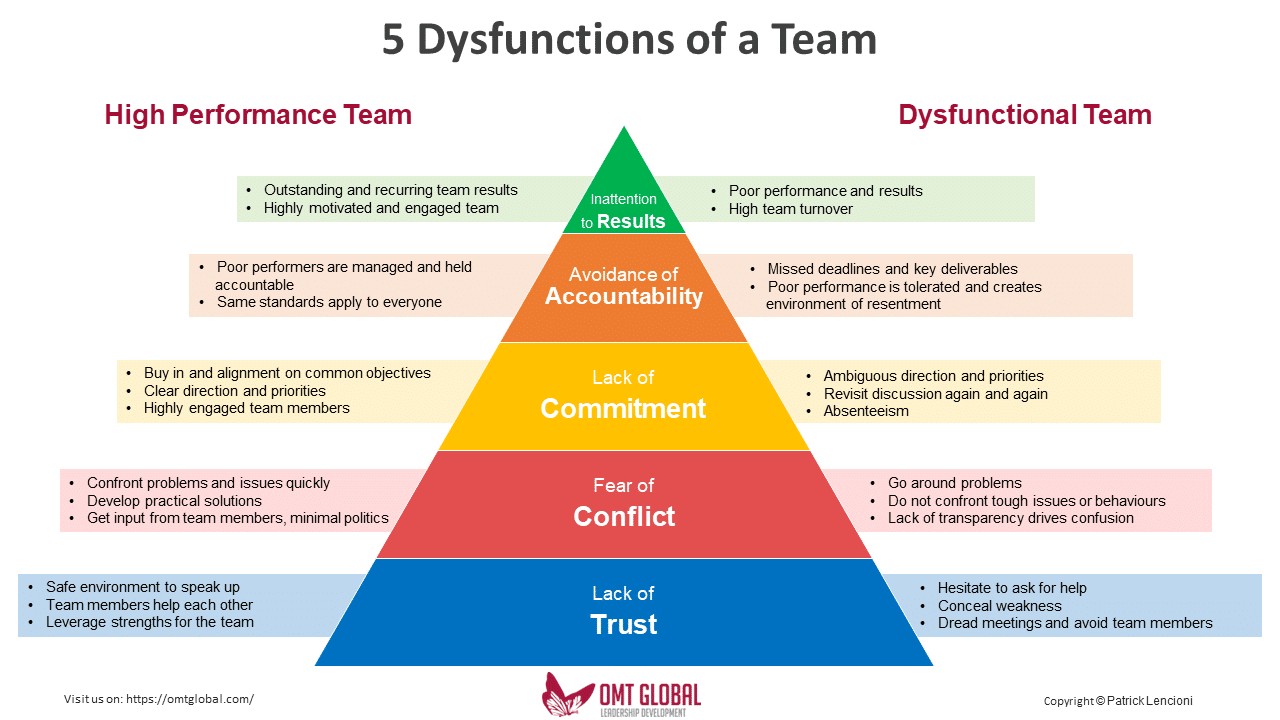
- The first dysfunction is an absence of trust among team members. Essentially, this stems from their unwillingness to be vulnerable within the group. Team members who are not genuinely open with one another about their mistakes and weaknesses make it impossible to build a foundation for trust.
- This failure to build trust is damaging because it sets the tone for the second dysfunction: fear of conflict Teams that lack trust are incapable of engaging in unfiltered and passionate debate of ideas. Instead, they resort to veiled discussions and guarded comments.
- A lack of healthy conflict is a problem because it ensures the third dysfunction of a team: lack of commitment. Without having aired their opinions in the course of passionate and open debate, team members rarely, if ever, buy in and commit to decisions, though they may feign agreement during meetings.
- Because of this lack of real commitment and buy-in, team members develop an avoidance of accountability, the fourth dysfunction. Without committing to a clear plan of action, even the most focused and driven people often hesitate to call their peers on actions and behaviors that seem counterproductive to the good of the team.
- Failure to hold one another accountable creates an environment where the fifth dysfunction can thrive. Inattention to results occurs when team members put their individual needs (such as ego, career development, or recognition) or even the needs of their divisions above the collective goals of the team.
Since PACE is a team ministry, we cannot ignore the importance of healthy teamwork. No one can build an effective ministry alone. A ministry may begin with one leader, but it grows and endures only through a committed team.
One of the most helpful books I have read on this subject is The Five Dysfunctions of a Team by Patrick Lencioni.
- Trust: Do We Hesitate to Ask for Help?
Lencioni teaches that the foundation of every healthy team is trust. One practical sign of trust is whether we are willing to ask one another for help.
Many people hesitate to ask for help because they fear appearing weak, incompetent, or dependent. This is understandable when people have only recently met. However, after serving together for months or even years, team members should feel free to seek advice, encouragement, prayer, or practical assistance whenever they need it.
This is an area where I have learned an important lesson about myself. By nature, I am rather introverted and reluctant to ask others for help. One of my ministry colleagues is just the opposite. He approaches me naturally and comfortably whenever he needs assistance. At first, I felt somewhat embarrassed by his openness. Later I realized that his willingness to ask for help was not a weakness but a sign of trust and healthy teamwork. Effective ministry teams are built by people who depend on one another rather than trying to carry every burden alone.
- Conflict: Don’t Fear Honest Discussion
The second principle is conflict. Whenever people work together toward a common goal, differences of opinion are inevitable. Conflict is not the real problem; avoiding healthy conflict is.
Many people try to preserve peace by remaining silent, but silence often prevents growth. During my ministry in Korea, I observed that some of the most capable leaders were not afraid of vigorous discussion. They debated ideas passionately, sometimes even strongly. Yet because everyone was seeking the best solution rather than personal victory, those discussions often produced wiser decisions and stronger unity.
Healthy conflict refines ideas, strengthens relationships, and helps a team make better decisions. When handled with humility and respect, conflict becomes a blessing rather than a threat.
- Commitment: The Fruit of Trust and Conflict
The third principle is commitment. Genuine commitment grows naturally when trust has been established and healthy conflict has taken place.
When team members trust one another and have honestly discussed important issues, they are much more willing to support the final decision. Even if everyone does not get exactly what they wanted, they move forward together because they know they have been heard and respected.
In my experience, commitment cannot be forced. It grows out of trust and honest dialogue. Once these two foundations are in place, team members become more united, more responsible, and more willing to sacrifice for the ministry. The team begins to move together with one heart and one vision.
Healthy ministry teams are not those without disagreements. They are teams that trust one another, handle conflict wisely, and remain committed to God’s calling together.
- Accountability: Do We Love the Team Enough to Speak the Truth?
The fourth principle is accountability. Accountability means having the courage to call one another to a higher standard. It is not criticism or judgment; it is an expression of care for the person and the mission.
Lencioni explains that unhealthy teams often avoid accountability because people fear damaging relationships or creating tension. They see silence as kindness, but in reality, silence allows unhealthy attitudes and behaviors to continue. When no one is willing to speak, the standard of the entire team gradually declines.
In ministry, this is especially important. Because we serve together for God’s Kingdom, we must care enough to speak the truth in love. A healthy PACE team should not ignore problems, excuses, or attitudes that weaken the ministry. Instead, members should lovingly encourage one another, correct one another, and help each other grow.
True accountability is not about finding faults; it is about helping each person become the servant God has called them to be. A team without accountability may have friendship, but it will struggle to maintain excellence and faithfulness.
- Results: Are We Seeking the Success of the Team or Ourselves?
The fifth principle is results. Lencioni points out that some team members become more concerned with personal success, recognition, status, or influence than with the success of the entire team.
This danger can also appear in ministry. A leader may focus on his own reputation, position, or achievements rather than asking, “Is the whole ministry growing? Are people being cared for? Is God’s purpose being fulfilled through our team?”
A healthy ministry team measures success by collective results, not individual accomplishments. The question is not, “How successful am I?” but “How successful are we together in fulfilling God’s calling?”
For PACE ministry, this means that every lay pastor, leader, and volunteer must remember that we are not building our own ministry; we are serving Christ’s ministry. When the team succeeds, everyone shares the joy. When one member struggles, everyone carries the burden together.
The ultimate goal of teamwork is not personal recognition but faithfulness to God’s mission. A mature team places the mission above ego, the Kingdom above personal status, and the success of others above personal achievement.
A healthy ministry team is built on five foundations: trust, healthy conflict, commitment, accountability, and results. When these five qualities are present, a group of individuals becomes a true team—united in heart, purpose, and service for God’s glory.